
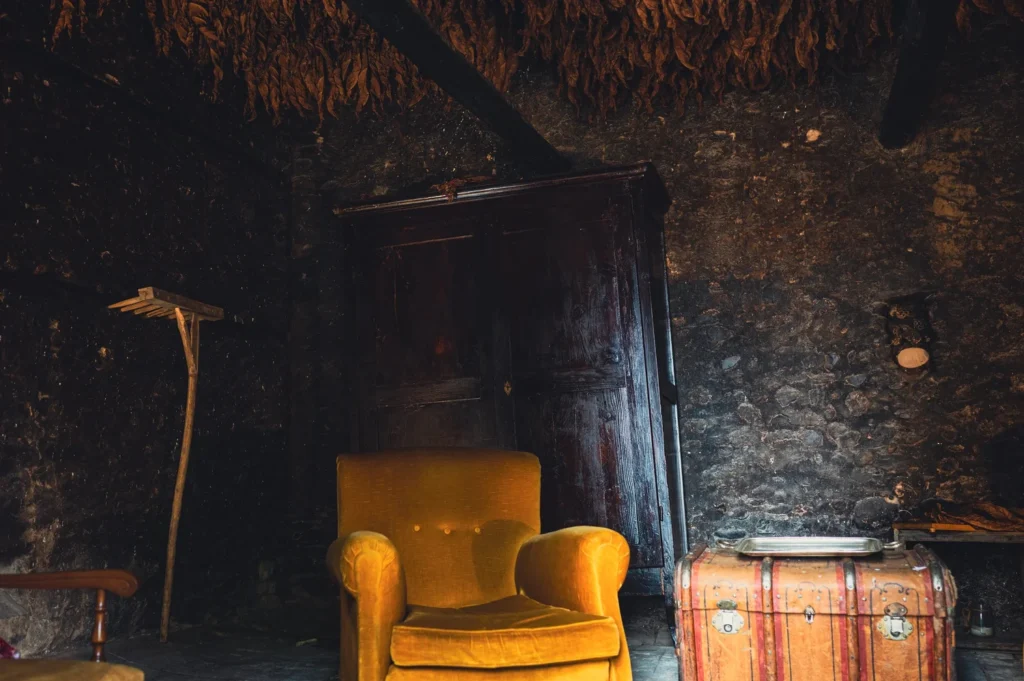
In this room, guests can relive stories of the past while tasting a fine selection of our cigars. This room, where tobacco was once dried, has become a sensory room for tasting cigars, chocolate, and grappa, or simply sitting and experiencing unique emotions. It's a sort of tobacco museum. In 1574, Cardinal Niccolò Tornabuoni sent some tobacco seeds, originally from Central America, to his nephew Alfonso Tornabuoni, bishop of Sansepolcro. Initially, the plant was used for medicinal purposes and to make snuff and pipe tobacco, but it soon developed into the dominant crop throughout the valley, distinguished by its excellent quality. The first significant cultivations date back to the early 1600s, in the nearby Republic of Cospaia (1440-1826). After the Republic ceased to exist, and the territory of Sansepolcro became part of it in 1867, following the unification of Italy, the municipality was granted the cultivation of 1,000,000 tobacco plants. Later, in 1868, the same concession was extended to the neighboring municipalities of Anghiari and Monterchi. Production and distribution were so great that in 1869, a tobacco storage facility was opened in the former Observant convent in Sansepolcro, and in 1896, this became the headquarters of the Tobacco Cultivation Agency.
In the early 1900s, Kentucky tobacco was grown throughout the Tuscan Tiber Valley, the only tobacco variety available. This type of tobacco was dried over a direct flame using oak wood, for which landowners built drying sheds, which still characterize the area today. In a distant but not forgotten past, tobacco production was subject to strict rules: if less tobacco was produced than expected, a fine of 50 or 60 lire per leaf was imposed; if more was delivered, a surcharge of 10 to 15 lire was imposed. Consequently, many growers were forced to smuggle tobacco to make ends meet, or rather, to have bread on the table every day. The smuggling brothers from Chitignano brought abundant gunpowder to exchange for tobacco from the Valtiberina farmers: the roads and paths traveled by the smugglers went from Anghiari to Ponte alla Piera, crossing the Rognosi Mountains.
Italy is the largest tobacco producer in Europe, and is almost exclusively responsible for the Kentucky variety. In Tuscany (according to Istat, SPA Survey 2005), tobacco is grown on an area of 2,761 hectares, mostly in the Val di Chiana and Valtiberina areas. Kentucky tobacco has been recognized as a traditional agricultural food product of Tuscany and included in the relevant regional list (Taverniti F). Today, Valtiberina Toscana produces 80% of the tobacco leaf used for the wrapper of the Tuscan cigar, the outer part of the tobacco leaf, consisting of the entire leaf, which is elastic and a uniform, vibrant brown. This area is home to approximately 200 companies covering over 500 hectares of cultivated land, with an annual production of approximately 12,000 quintals (APROTAB, 2007). Kentucky tobacco produced in the Tiber Valley is the leading pre-manufacturing industry in Tuscany. Percentages of tobacco production for each affected municipality (ATAC, APROTAB, AGRICOPER, ARPT data, 2007).
CROP CHARACTERISTICS AND WORK PHASES
The high quality of Kentucky blueberries is due to and linked to soil, climate, geography, and water availability; for this reason, the Tuscan Tiber Valley is a particularly suitable area for this type of crop.
POLLINATION
The corolla is removed from the plant's flowers to reveal the pistil, on which the pollen of another variety is then placed, from which the hybrid tobacco seed is obtained.
SEEDBED
The seedbed is prepared in February; after about 30 days, the seedlings emerge and are transplanted in May. This operation was once done manually by teams of workers using pegs, which they used to drive the seedlings into the ground in regular rows (about 10,000 seedlings/ha).
COLLECTION
Harvesting is done entirely by hand, between August and late September. Approximately 10-12 leaves, selected from the finest, are picked from each plant; these are taken to the drying room, a brick-built room for curing tobacco, where they are threaded onto strings that are then attached to wooden poles resting on the drying room's frame.
TREATMENT
Yellowing and browning
Kentucky hash is dried over a direct fire using oak wood; modern dryers have introduced the kiln, where the fire is below floor level and heat is supplied through hot air ducts. After 20 days, the leaves turn brown, acquiring a strong aroma and the right level of humidity, which is crucial because if it is low, the leaves risk tearing; if it is high, there is a risk of mold forming after sorting. The leaves are selected individually, divided into classes: band (dark and light), cut, band and band (dark and light), heavy filler, light filler, and shredded. The leaves are bundled and placed in cardboard boxes identified externally by sorting category.
FROM KENTUCKY TO THE TUSCAN CIGAR
Christopher Columbus recounts in his log that when he landed in America, he encountered natives inhaling the smoke of rolled, lit leaves. Tobacco arrived in Europe about fifty years after the discovery of the New World. It seems that the first tobacco crops in Italy developed in the Grand Duchy of Tuscany, toward the end of the 16th century, but for a long time the largest and most valuable crop continued to be imported tobacco, arriving sealed in wooden barrels. Tradition holds that the Toscano cigar was born by chance in Florence, toward the end of the 18th century, when a batch of Kentucky tobacco, left outdoors, was hit by heavy rains that soaked and then submerged the barrels containing the tobacco. Left exposed to water and sun, the Kentucky tobacco leaves fermented, taking on a foul odor, and it was decided to throw them away. However, some people tried drying them and rolling them into cigars to sell at a low price. Those cigars, hereafter referred to as stortignaccoli, sold like hotcakes and marked the birth of the legendary Toscano cigar. In 1818, under the leadership of Ferdinand III, the first cigar factory, called Manifattura di Sant’Orsola, or Centrale, was opened in Florence. It operated for approximately 130 years until it moved to the new tobacco factory in Cava dei Tirreni, inaugurated in late 1940. The Toscano cigar is still produced today in Lucca, arguably the Italian capital of the Toscano cigar, and in Cava dei Tirreni. In July 2006, the Toscano cigar brand, as well as the facilities and factories used to produce it, including the buildings, were purchased by the Italian group Maccaferri (owner of the entire Eridania sugar mill chain), which purchased the entire supply chain from British American Tobacco, which in turn was acquired by the Italian Tobacco Authority (ETI) after the end of the State Monopolies.
…AND MORE: ALTERNATIVE USES OF TOBACCO
It's remarkable how, over the years, the importance of this agricultural product has further developed in the most diverse sectors, such as the confectionery and culinary one, where the creativity of experts has yielded some truly original results. ...from tobacco chocolate and Toscano cigar-flavored ice cream, to tobacco-flavored cured meats and cheeses aged with tobacco leaves... In the pharmaceutical field, the first steps have been taken towards extremely interesting studies; in the literature, tobacco has a long history as a successful crop for the production of numerous complex molecules of various origins (Plant Molecular Farming) and is therefore a leading candidate for the commercial production of certain types of drugs. Antibiotics: being male-sterile, the Kentucky variety can be pollinated with interesting varieties carrying genetic improvement traits and can be considered a valid candidate for the production of recombinant molecules with therapeutic action (Pisani M., 2006). Leaf: from these we obtain elastin, a protein found in human connective tissue, which can be used in reconstructive tissue surgery, in the production of eco-friendly plastics, and in the production of enzymes useful in the treatment of rare diseases.